

Keepers of Secrets
Old buildings, like families, are keepers of our secrets and lore. As a practicing architectural historian in New Orleans, I unearth and interpret these secrets, which are embedded in a building’s materials (wood, brick, iron) and physical spaces as well as in the lives of the generations of people who shaped, used,and altered them. A building’s lore– “this house survived the 1788 fire,” or “that bank had a speakeasy during Prohibition” – provides another layer of mystery and meaning (and, sometimes, a false path). Secrets and lore provide answers that help me guide a building’s future because, in planning a historicrehabilitation, we ask: what is true to the building? What should we keep, and what can we let go?
I come by this line of work honestly. My father, whom we lost in 2025, was a lover of old buildings and the keeper of our family’s history, rescuing stacks of fragile letters and photos as a young teen when my grandfather was tossing them out. My unsentimental grandfather, meanwhile, founded French Quarter Realty in the mid-1960s at the corner of Bourbon and St. Ann Streets; he had recently inherited several commercial and residential French Quarter properties from the family members in those old photos, quit his job as a high school physics teacher, and embraced the real estate business.
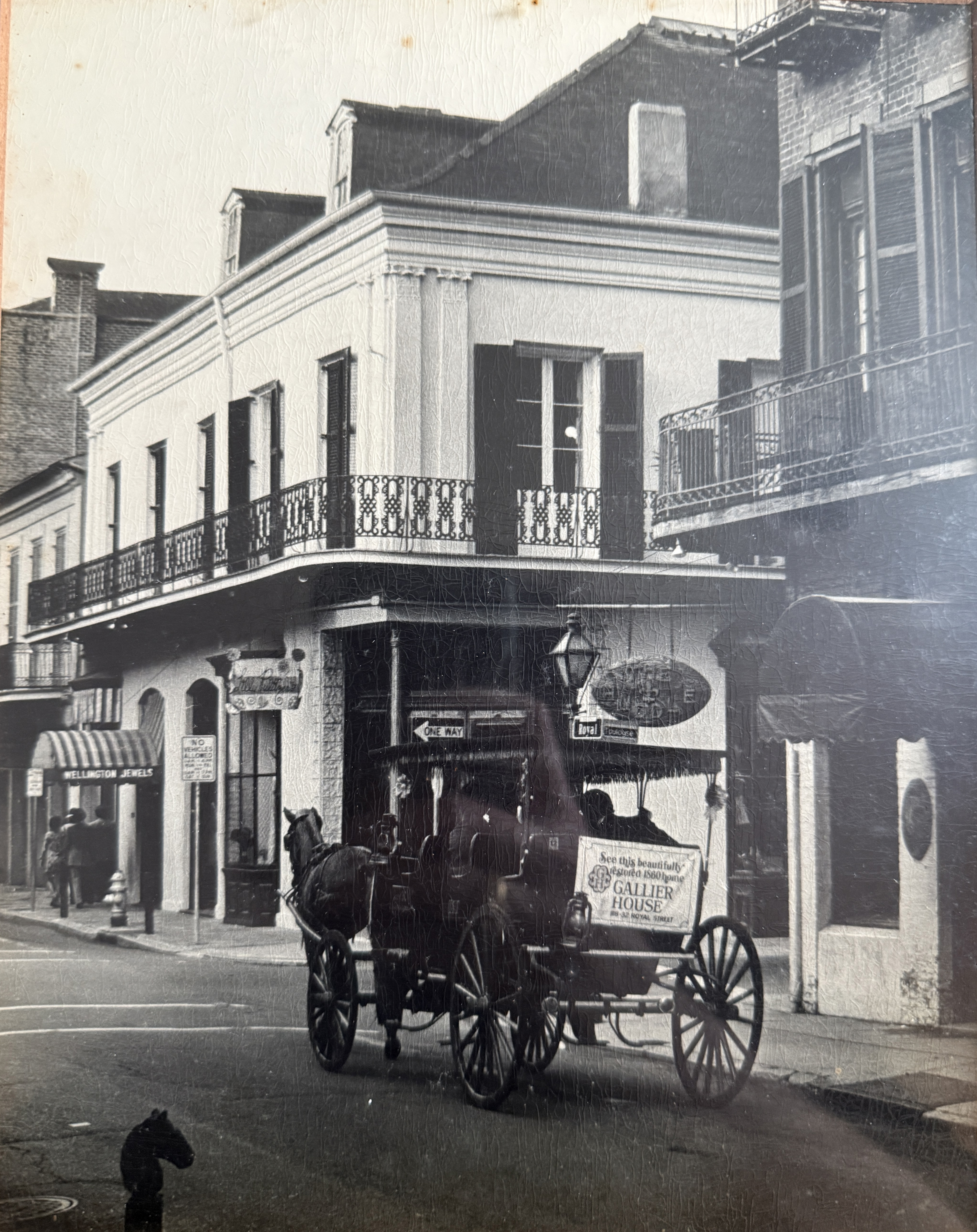
One of these inherited properties was the stately mixed-use building at 708 Toulouse Street/537-41 Royal Street, an 1819 design by famed American architect Benjmain Latrobe that the Begues call simply “Royal and Toulouse.” (Bonus: Latrobe died of yellow fever in New Orleans in 1820, making our property one of his last designs alongside the Louisiana State Bank, known as “Latrobe’s on Royal,” at 403 Royal Street. Latrobe’s illustrated—and often pointed—observations about his brief time in New Orleans are available online and worth the read.)


When I was growing up in the 1980s and early 1990s, my father assembled his own collection of old buildings in Faubourg Marigny, where we lived on Washington Square. On neighborhood walks and from the car, he would point here and there, drilling into me the difference between a Creole cottage and a shotgun (look at the direction of the roofline!), the beauty of double-hung sash windows with watery float glass (precious!), and the necessity of shutters in good working order. Was I often bored to tears? Absolutely.

My father was also a dynamic and full-throated storyteller who loved telling us tales of our French ancestors. I took them as gospel truth and incorporated them into my identity, especially when I moved North for college. But, since all storytellers are known to embellish, I grew skeptical as an adult. Begue family history is rife with wild, borderline-outlandish details: what was fact and what was closer to fiction?
The current renovation of Royal and Toulouse had me mulling over one particular tale about how we came to own it in the first place. So, recently I decided that it was long past time for me to flex my research skills and investigate.
My father’s story begins with Jean Begue, my grandfather’s grandfather. Jean arrived in New Orleans in 1869 from Antin, a blip of a farming village in the Hautes-Pyrénées region of southwest France. He was 19 when he decided to join his two uncles and his older cousin, Hypolite, all of whom were working as butchers in the French Market. Jean, who also went by John or Juan after his arrival, became a butcher himself and eventually had his own stall in the French Market, No. 102.
This is the kind of story that countless American families share, right? But here is where things take a turn. One day, as my father tells it, young Jean “won the Cuban lottery,” specifically “$10,000 in gold.” A Cuban lottery? In New Orleans? How? Why?
Well. To my surprise, the Havana Lottery was indeed very real and very popular in New Orleans in the 1870s, at the very time that Jean was toiling away at his butcher stall. Drawings were announced in local newspapers, with prizes ranging from $500,000 down to $1,000 (in Spanish currency or “gold”). Tickets were sold in cities across the eastern half of the United States, including Charleston, New York, and Cincinnati, but it was especially popular in New Orleans. In the 1840s and 1850s, winning numbers were allegedly delivered from Havana to New Orleans via carrier pigeon. In the 1860s and later, they arrived via the much more mundane telegraph service.
The Louisiana Legislature even passed a law in 1874 that only the home grown Louisiana State Lottery could operate legally in the state, but that did not stop the Havana Lottery. Tickets continued to be sold in New Orleans, and the arrests of ticket sellers were as frequently reported on as the lottery’s drawings and winners. In 1877, the Daily Picayune reprinted an article from the Philadelphia Times about a New Orleans tailor who had won “$10,000 in gold” from the lottery in 1875 and then moved to Pennsylvania, where “his success turned his head” and he proclaimed that he was the Son of God.
The newspapers did not specifically report Jean Begue as one of the lottery winners, but this was common practice. Winners were routinely unnamed unless they won the largest prizes, and sometimes they comprised anonymous groups of individuals who shared the cost of the ticket (and then the pot). Several prizes were awarded in New Orleans, including $100,000 in 1876 “by a party of gentlemen,” $500,000 in 1877 by unnamed parties, and another $100,000 in 1878. Jean could have shared in any of these winning tickets to claim his $10,000.
My father would then tell us that Jean could not decide whether to invest his winnings in the railroad or in real estate, and that his new wife, Jeanne, wisely recommended the latter. In 1880, Jean purchased Royal and Toulouse for…$10,000.
Jean went on to buy twelve properties in total in the 1880s and 1890s, some of which were later sold. One that remains with us is 731 Orleans Street, where Jean built a two-story galleried house as his family home. And yet, despite his substantially increased net worth, Jean continued to work as a butcher in the French Market until at least the early 1900s. He died in 1928.
So that is how the Begues acquired Royal and Toulouse. But to paint the fullest picture, it is worth mentioning what Hypolite, Jean’s older cousin, was up to while Jean was buying up real estate. Hypolite had left the butcher business to become the charismatic saloon keeper at a restaurant at the corner of Decatur and Wilkinson Streets, just across from the French Market. In 1882, he married the restaurant’s talented cook, Elizabeth Kettering (widow Dutrey), who became Madame Begue.


Together Hypolite and Elizabeth built Begue’s, a world-famous restaurant full of its own secrets and lore, including the (true!) story that Madame Begue invented brunch—a breakfast-y and boozy feast for the butchers after long shifts at the French Market. I like to think that Jean visited Hypolite and Elizabeth often for one of their famously indulgent meals.
Now, in 2026, with the help of Gene Guidry, the Begues are making much-needed repairs and renovating a portion of the second floor into two beautiful apartments. That particular space had been long neglected, first divided into rooms for rent during the Great Depression (by Jean’s daughter, my Great-Great-Aunt Louise), and later rented to a national housewares company by my grandfather as a “warehouse” for their ground-floor store; employees nearly destroyed the interior and, in subsequent years, my father and uncle struggled to agree on how to deal with the wreckage. That did not stop us, however, from thoroughly enjoying the wrap around-balcony for many years of Mardi Gras, but now it is time to share that privilege with others.
I will be among the fifth generation to steward these Begue properties into the future. And, like my father, I will relish retelling our family’s stories, the more outlandish the better, because they are true to us.
About the Author
Gabrielle Begue is a practicing architectural historian in New Orleans. She owns a local preservation consulting practice focusing on historic tax credits, National Register nominations, and property research.
